
Yonex Badminton String Guide 2026: BG, Exbolt, Nanogy & Aerobite Series Explained
At our Edison showroom, we see buyers choose rackets by brand first and specs second. We recommend the opposite. The four Yonex string families below (BG, Exbolt, Nanogy, and Aerobite) cover most recreational and club needs in the US market. Live pricing, gauges, and stock change often, so always confirm details on the badminton collection page.
Start With Player Level and Playing Style
String choice follows the player, not the other way around. A beginner needs control and durability; an advanced club player wants repulsion and feel. Recreational players who hit once or twice a week need different string tension than daily training athletes.
We recommend beginners start with mid-thickness strings around 0.70mm for longer life. Intermediate and advanced players often step down to 0.61-0.66mm for better feel. Match tension to the racket head, not the string alone; check the racket's recommended range before cutting.
Skill Tier at a Glance
- Beginner / casual: durable strings, 0.70mm+, lower tension (20-24 lbs).
- Intermediate / club: balanced all-rounders, 0.66-0.70mm, 22-26 lbs.
- Advanced / competitive: thin, high-repulsion strings, 0.61-0.66mm, 24-30 lbs (varies by model).
Weight, Balance, Flex and Grip Explained
Racket weight changes swing speed and arm fatigue. Lighter frames (4U, 80-84g) swing faster and suit doubles defenders. Heavier frames (3U, 85-89g) carry more power for singles baseline rallies.
Balance point shifts the feel. Head-heavy rackets add smash power; head-light rackets help quick net exchanges. Shaft flex matters too: flexible shafts bend more on contact (good for slower swings), while stiff shafts transfer energy faster (good for hard hitters).
Grip size is the most overlooked spec. A grip too small forces squeezing and causes wrist strain; too large reduces wrist snap. We recommend a grip that lets fingers wrap fully with a small gap at the heel. Most Yonex rackets ship in G4 or G5; replacement overgrips can fine-tune the size.
Quick Reference
- Weight: 4U for speed, 3U for power.
- Balance: head-heavy for smashes, head-light for control.
- Flex: flexible for timing, stiff for direct power.
- Grip: G4 (smaller) vs G5 (larger); add overgrip to adjust.
Singles vs Doubles and Indoor-Use Differences
Singles rallies are longer and rely on stamina, depth, and angle. Doubles points are shorter and reward speed, net play, and quick drives. The right racket setup reflects that.
For singles, we recommend a slightly heavier, head-balanced racket with a medium-stiff shaft. For doubles, a lighter, head-light racket with a flexible shaft helps react at the net. Indoor court climate also matters: dry winter air makes strings brittle, so lower tension by 1-2 lbs in cold months.
Court and Climate Notes
- Climate-controlled gyms: standard tension applies.
- Cold or dry halls: reduce tension by 1-2 lbs to avoid breakage.
- Outdoor play: avoid high-end strings; durability matters more than feel.
Product Comparison by Buyer Type
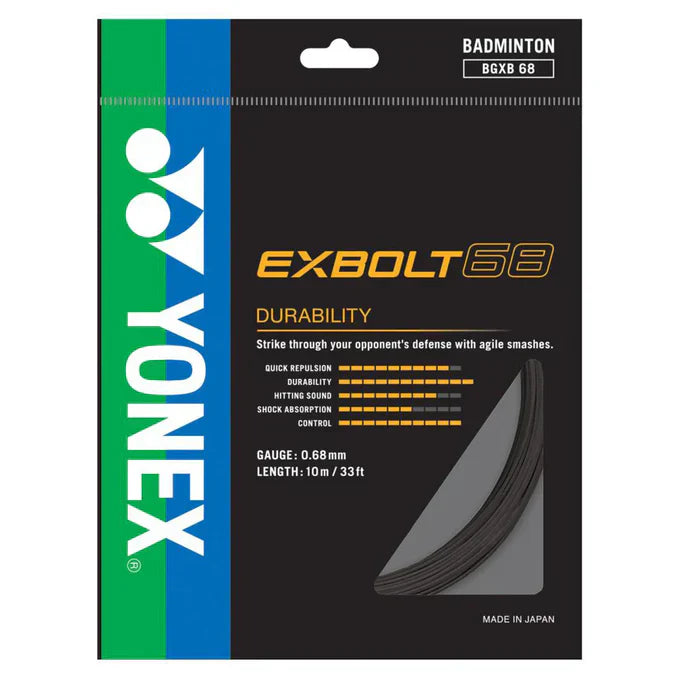
The four Yonex string families serve different needs. BG covers classic multifilaments and entry options. Exbolt focuses on high-repulsion co-polymers for hard hitters. Nanogy uses a unique hybrid fiber for soft feel. Aerobite is a hybrid pre-cut string built for control and durability.
Use the guide below to match your buyer profile. Live specs, gauges, and prices are on each badminton racket product page.
Decision Table by Buyer Type
- Beginner / casual player: Best fit: BG65 or similar durable multifilament. Avoid when: you want maximum repulsion or plan to string above 26 lbs. Key verification: confirm gauge (0.70mm+), tension rating, and racket head compatibility on the product page. Relevant collection: badminton.
- Intermediate / club player: Best fit: Exbolt 63 or Nanogy 95 for balanced feel. Avoid when: you break strings weekly or play outdoors. Key verification: check string length (10m vs 200m reel), gauge, and recommended tension range. Relevant collection: badminton rackets.
- Advanced / competitive player: Best fit: Aerobite hybrid or Exbolt 65 for thin, sharp feel. Avoid when: you have not yet built consistent swing speed. Key verification: verify string type (hybrid vs solid), gauge (often 0.61-0.66mm), and pro-only tension limits. Relevant collection: badminton.
- Coach / stringer buying in bulk: Best fit: 200m reels of BG65, BG80, or Exbolt. Avoid when: only one-off stringing jobs are needed. Key verification: confirm reel vs set, machine compatibility, and current stock. Relevant collection: badminton.
Three US Buyer Scenarios
Scenario 1 — College club player in Boston: Plays 3-4 times a week indoors, wants a thin string for feel. We recommend a 0.66mm Exbolt at 24 lbs in a 4U racket. Avoid high-tension setups that risk breakage in dry winter halls.
Scenario 2 — Parent buying for a 12-year-old beginner in New Jersey: Needs durability and control, not power. We recommend a durable BG-series multifilament at 21-23 lbs in a lightweight 4U racket. Add an overgrip for smaller hands.
Scenario 3 — Recreational doubles player in California: Plays weekend mixed doubles, wants quick net response. We recommend a head-light, flexible-shaft racket strung with a hybrid like Aerobite at 23-25 lbs. Avoid stiff, head-heavy frames that lag at the net.
Compare current badminton rackets and strings online or visit the Edison, NJ store to check racket feel and grip. Call or WhatsApp 1-732-250-3598 for help choosing the right setup.
Common Buying Mistakes
We see the same errors from new buyers every week. Avoiding these saves money and frustration.
- Stringing too tight too soon: High tension without a fast swing causes off-center hits and broken strings. Match tension to your swing speed, not the pros.
- Buying by brand only: Yonex, Victor, and Li-Ning all make good rackets. Specs matter more than the logo.
- Ignoring grip size: A wrong grip causes wrist pain and limits control. Test grip size at our Edison showroom before you commit.
- Mixing string and racket types: A stiff, head-heavy racket with a thin, high-repulsion string often feels harsh. Pair similar profiles.
- Skipping shuttle match: Feather shuttles need different string setups than plastic. Match string and tension to your shuttlecock choice.
Care, String, and Shuttle Guidance
String life depends on play frequency and tension. Recreational players can expect 2-4 months per restring; daily players may need monthly restringing. Watch for fraying, notching, and loss of tension as signs to re-string.
Store rackets in a cover at room temperature. Avoid leaving them in a hot car; heat warps frames and weakens strings. Use a dampener only if you want a softer feel at impact; it does not protect strings.
Shuttle choice changes feel. Feather shuttles offer the best flight but cost more and break faster. Plastic shuttles last longer and suit practice or outdoor play. Match string tension to shuttle type: feather shuttles pair well with slightly lower tension for control; plastic shuttles can handle higher tension for power.
For related reading, see our best badminton equipment guide and our choosing the right racket guide.
Frequently Asked Questions
What is the difference between BG and Exbolt strings?
BG is Yonex's classic multifilament line, focused on durability and all-round play. Exbolt is a newer co-polymer line aimed at higher repulsion and thinner gauges for advanced players. Match the line to your swing speed and frequency.
How often should I restring my badminton racket?
Most recreational players restring every 2-4 months. Club and competitive players restring monthly or sooner. Replace strings when you see fraying, notching, or notice a loss of tension and power. Frequency matters more than the calendar.
What tension should a beginner use?
Beginners should start in the 20-24 lb range, depending on racket head and string gauge. Lower tension offers more control and forgiveness. Step up tension only when swing speed and consistency improve. Check your racket's recommended range first.
Are feather or plastic shuttlecocks better for practice?
Plastic shuttles are cheaper, more durable, and best for outdoor or high-volume practice. Feather shuttles fly more accurately and are required for sanctioned tournament play indoors. Match string tension to your shuttle choice for the best feel.
Can I use the same string for singles and doubles?
Yes, but consider two rackets if you play both seriously. Doubles favors lighter, head-light rackets with flexible shafts; singles often suits slightly heavier, head-balanced setups. String choice can stay similar; frame balance usually changes between formats.
Related Guides
- Best Badminton Equipment Guide 2026: Yonex Rackets, Strings, Shuttles
- Choosing the Right Badminton Racket for Your Playing Style
Compare current badminton equipment online or visit our Edison, NJ showroom to check racket feel and grip in person. Call or WhatsApp 1-732-250-3598 for help choosing the right string and racket setup for your level.
FAQ
What should I consider first?
Fit and how you play matter more than brand or price. Visit our Edison, NJ showroom or message us on WhatsApp for guidance.
Can beginners use this equipment?
Yes. Start with gear matching your current level and upgrade as your skills improve.
How do I choose the right size?
Check manufacturer sizing charts on product pages. Message us if you need help fitting.